
Sermon Summary: Salvation By Faith Alone In Christ Alone. Preached on June 28, 2026
Acts 15 records one of the most significant moments in the history of the early church. A serious dispute arose when some Jewish believers taught that Gentiles had to be circumcised and obey the Law of Moses in order to be saved. This teaching threatened the very heart of the gospel by adding human effort to Christ’s finished work.
At the Jerusalem Council, the apostles and church leaders carefully examined both Scripture and the evidence of God’s work among the Gentiles. Peter testified that God had already accepted Gentile believers by faith and given them the Holy Spirit apart from the Law. Paul and Barnabas confirmed how God had transformed lives through their missionary work, while James demonstrated that these events fulfilled Old Testament prophecy.
The council concluded that salvation comes through the grace of Jesus Christ alone. The church must never place unnecessary barriers in front of people who are coming to faith. While obedience and spiritual growth matter, they are the result of salvation—not the means of earning it. The gospel remains unchanged: forgiveness, acceptance, and eternal life are received by trusting in Christ alone, not by adding religious performance or personal merit.
Key Scriptures
- Acts 15:1–21
- Acts 10 (Peter and Cornelius)
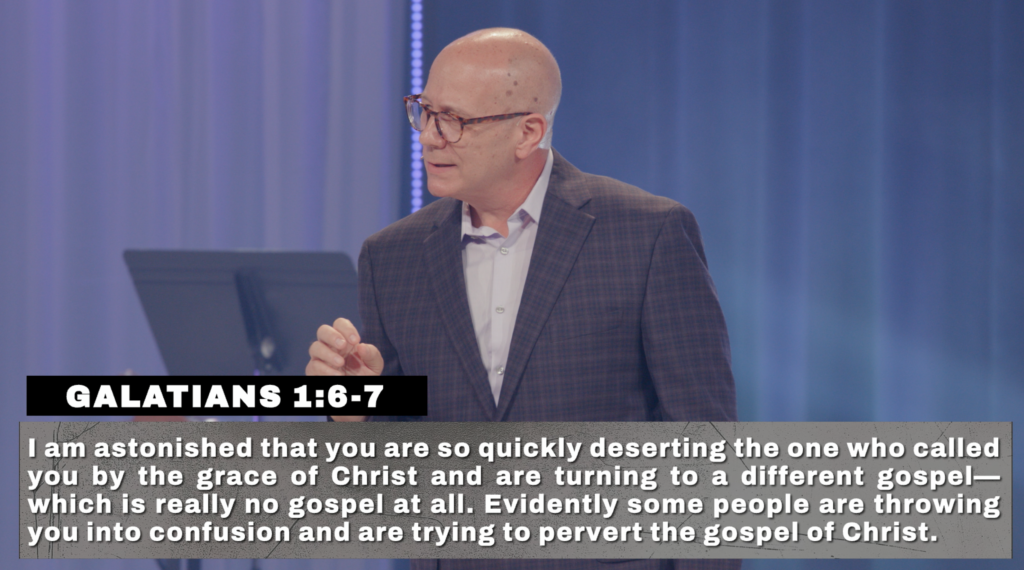
- Galatians 1:6–7
- Amos 9:11–12 (quoted in Acts 15:16–18)
- Genesis 12:1–3 (Abrahamic Covenant, referenced)
- 2 Corinthians 1:20 (All God’s promises find their “Yes” in Christ)
- 1 Timothy 1:8 (The law is good if used properly)
- Romans 8:16 (The Spirit bears witness that we are God’s children)
Key Themes
- Salvation by grace through faith
- Christ alone for salvation
- Acts 15 and the Jerusalem Council
- The danger of legalism
- The gospel versus religious works
- Grace versus law
- The purpose of the Mosaic Law
- Unity in the early church
- Removing barriers to the gospel
- Biblical decision-making
- Faith and obedience
- The sufficiency of Christ
Sermon Outline
I. Missing the Point of the Gospel
The sermon begins with the story of the Wright brothers, illustrating how people can completely miss the most important part of a message. In the same way, many people understand facts about Jesus while still missing the heart of the gospel. Acts 15 addresses one of the greatest threats to the early church because the purity of the gospel itself was at stake. The central question is simple: Is Jesus enough?
II. The Conflict
The Dispute Over Circumcision
Certain Jewish believers insisted that Gentiles had to become Jews by following circumcision and the Law of Moses before they could become Christians. This teaching transformed the gospel from “Christ alone” into “Christ plus something else.” Paul strongly opposed this message because any addition to Christ changes the gospel into something entirely different. Salvation has never been based on religious performance but on God’s grace.
III. The Jerusalem Council Examines the Evidence
Church leaders gathered in Jerusalem to settle the dispute. The Pharisee believers presented their position, Peter testified about God’s work among the Gentiles through Cornelius, and Paul and Barnabas described God’s miraculous work during their missionary journeys. James listened carefully to every testimony before comparing it with Scripture. The council modeled biblical leadership by allowing experience to be evaluated through God’s Word rather than replacing it.
IV. Scripture Confirms the Gospel of Grace
James quoted the prophet Amos to demonstrate that God’s plan had always included the salvation of the Gentiles. The inclusion of all nations was not a new idea but the fulfillment of God’s promises throughout the Old Testament. Scripture confirmed what God was already doing. The gospel revealed God’s consistent plan of redemption from beginning to end.
V. The Conclusion: Don’t Make It Difficult to Come to Christ
The Jerusalem Council concluded that Gentiles should not be burdened with unnecessary religious requirements. Their instructions promoted unity within the church without making those practices conditions for salvation. Churches today should also evaluate whether traditions, preferences, or cultural expectations become obstacles that keep people from hearing the gospel. The message of Christ must remain central.
VI. Christ Alone Is Enough
The sermon concludes with a personal invitation to trust Christ completely. No one can earn God’s acceptance through moral effort or religious activity. Every believer comes to Jesus with nothing to offer except the need for His grace. Salvation is God’s gift, received by faith in Christ alone.

FAQ
Acts 15 teaches that salvation comes through faith in Jesus Christ alone, not through keeping religious laws or performing good works. The Jerusalem Council affirmed that God’s grace is sufficient for salvation.
The Jerusalem Council was a gathering of apostles and church leaders who met to resolve whether Gentile believers had to follow the Jewish Law to become Christians. Their decision protected the gospel of grace and preserved unity in the early church.
Some Jewish believers believed that Gentiles needed to become Jews before becoming Christians. They viewed circumcision and obedience to the Law of Moses as necessary for salvation, a teaching the apostles rejected.
Yes. Christians obey God because they have already been saved, not in order to earn salvation. Good works are the fruit of genuine faith, not the basis of acceptance before God.
“Christ alone” means Jesus’ death and resurrection are completely sufficient to save sinners. Nothing can be added to His finished work—not religious rituals, personal morality, or human effort.
Legalism is the belief that keeping religious rules earns God’s acceptance or contributes to salvation. The Bible teaches that salvation is a gift of grace received through faith in Jesus Christ.
Churches should distinguish between essential biblical truth and cultural or personal preferences. While holding firmly to the gospel, they should avoid making non-essential traditions requirements for following Christ.
Full Transcript
Full Sermon Transcript
In Christ Alone: Why Salvation Is by Grace, Not Works
On a brisk December day in 1903, Orville and Wilbur Wright finally accomplished what many believed was impossible. After numerous attempts at Kitty Hawk, North Carolina, they successfully flew their airplane. Filled with excitement, they sent a telegram to their sister, Katharine, in Chicago. It read, “We have actually flown 852 feet. We’ll be home for Christmas.”
Overjoyed, Katharine rushed to the local newspaper and handed the telegram to the editor. After reading it, he smiled and replied, “Well, how nice! The boys are going to be home for Christmas.”
He completely missed the point.
The Wright brothers had just accomplished one of the greatest achievements of the twentieth century, yet the editor overlooked the headline because he focused on the least important part of the message.
I believe there are countless people around the world—and perhaps some listening today—who have done the same thing with the gospel. They believe in Jesus, attend church and participate in worship. Yet they’ve missed the point. They’ve missed the very heart of the gospel.
Acts 15, the chapter we come to in our study through the book of Acts, may be the most important chapter in the entire book. At the very least, it belongs among the top three. Why? Because the purity and power of the gospel were at stake.
Let’s explore what happened.
I. The Conflict
The conflict begins in Acts 15:1:
“Some men came down from Judea to Antioch and were teaching the brothers: ‘Unless you are circumcised, according to the custom taught by Moses, you cannot be saved.'”
The issue was straightforward but incredibly significant. Some Jewish believers insisted that becoming a Christian first required becoming a Jew. For men, that meant circumcision. For everyone, it meant obeying the laws and customs given through Moses.
Now, it’s important to understand why this was even a discussion.
God had indeed established circumcision as the sign of His covenant with Abraham. Through Abraham’s descendants, God promised that the Messiah would come into the world. When Jesus Christ was born, that promise reached its fulfillment.
But God’s covenant with Abraham included another promise as well: that all the nations of the earth would be blessed through him. God’s plan was never limited to one nation. From the very beginning, His purpose was global. His intention was always to redeem people from every tribe, language, and nation through Jesus Christ.
Unfortunately, many in the Jewish community misunderstood that plan. They viewed Jesus not as the fulfillment of Judaism but as an addition to it. In their minds, salvation required Judaism plus Christ.
In other words, they had completely missed the point.
They traveled to Antioch and later to the churches Paul and Barnabas had established throughout Galatia, teaching believers that Jesus alone was not enough. According to them, faith in Christ still required obedience to the Mosaic Law.
Paul recognized immediately how dangerous this teaching was.
Writing to the Galatian churches, he said:
“I am astonished that you are so quickly deserting the one who called you by the grace of Christ and are turning to a different gospel—which is really no gospel at all.”
Those words are remarkably strong.
Paul doesn’t describe their teaching as a minor disagreement or a different theological emphasis. He calls it “a different gospel.” In fact, he says it isn’t the gospel at all. It is a corruption of the true message of Christ.
Why?
Because salvation is found in Christ alone.
Christ plus nothing.
Every road in the Old Testament ultimately leads to Jesus Christ. The sacrifices, the ceremonies, the priesthood, the feasts, the temple, and every promise of God all point forward to Him. Once Christ came, those shadows found their fulfillment.
You’ll never fully understand the Old Testament until you read it through the lens of Jesus Christ. Every promise ultimately finds its “Yes” in Him.
The Same Danger Today
Although circumcision may not be the issue today, many people still approach Christianity with the same mindset.
Years ago, Debbie and I knew a wonderful missionary named Lavinia McCart, who spent many years serving in Japan. She explained that many Japanese families practiced Shinto and kept what was commonly called a “god shelf” in their homes. Various symbols representing different gods would be displayed together on that shelf.
When people heard about Jesus, many responded positively. They appreciated His teachings and gladly welcomed Him—but instead of replacing their other gods, they simply added Jesus to the shelf.
He became one more option among many.
But that’s not the gospel.
If Jesus is Lord, the shelf has to be cleared.
Christ does not simply become another addition to our lives. He becomes our only hope.
The problem in Acts 15 was “Christ plus circumcision.”
Today, people often substitute different additions.
Some believe it is Christ plus baptism.
Others believe it is Christ plus speaking in tongues.
Some insist it is Christ plus a particular understanding of prophecy.
Others make it Christ plus observing a specific day, following certain traditions, maintaining particular lifestyles, or achieving enough moral goodness.
Many of these subjects are important. They deserve careful biblical study.
But none of them can be added to Christ as conditions for salvation.
The moment we say Christ is not enough, we’ve moved away from the gospel.
That raises an important personal question.
What are you trusting for your salvation?
Are you convinced that Christ’s death on the cross completely paid for your sins?
Or do you believe you still have to contribute something?
Do you imagine that Jesus paid ninety percent while you must somehow earn the remaining ten?
After more than thirty years of ministry here in New York’s Capital Region, I’ve become convinced that many sincere people still believe salvation is Jesus plus something else.
That belief spreads like a virus.
It weakens the church.
It steals assurance.
Most importantly, it distorts the gospel itself.
The true gospel declares that our hope is found in Christ alone.
Recognizing the seriousness of this issue, the church at Antioch sent Paul, Barnabas, and several others to Jerusalem to meet with the apostles and elders. The question was too important to ignore.
The church needed clarity.
And so the Jerusalem Council convened.
Full Clean Transcript (Part 2)
II. The Consultation
The church gathered in Jerusalem to address this issue through what is often called the Jerusalem Council. James, the brother of Jesus and the recognized leader of the church in Jerusalem, served as the chairman of the meeting.
Rather than rushing to a conclusion, the leaders listened carefully to the evidence, heard testimony from multiple voices, examined the Scriptures, and sought God’s wisdom together. It’s a model for how the church should address significant theological questions.
The Pharisee Believers Present Their Case
The first to speak were believers who had previously belonged to the party of the Pharisees.
They argued:
“The Gentiles must be circumcised and required to obey the law of Moses.”
Notice the certainty in their language.
They said, “must.”
They said, “required.”
Earlier they had insisted, “Unless you are circumcised…you cannot be saved.”
Their conviction was sincere, but sincerity alone doesn’t make a belief true. They believed obedience to the Mosaic Law was essential for salvation. In their minds, Jesus was important—but He wasn’t sufficient.
That was the issue before the council.
Peter’s Testimony
After much discussion, Peter stood to address the gathering.
He reminded everyone of what God had done through his ministry to Cornelius, the Roman centurion described in Acts 10. God had chosen to bring the gospel to Gentiles, and when they believed, He gave them the Holy Spirit just as He had given the Spirit to Jewish believers.
God Himself had made no distinction between Jew and Gentile.
Their hearts had been purified by faith.
Then Peter asked a powerful question.
Why would anyone place a burden on Gentile believers that even the Jewish people had never been able to carry?
The Law had always revealed humanity’s inability to save itself. Generation after generation had failed to keep it perfectly. Instead of producing righteousness, it exposed the depth of human sinfulness.
That was one of God’s purposes for the Law.
It functions like a teacher leading us to Christ. It reveals our need for grace by showing us that we cannot rescue ourselves.
Peter concluded with one of the clearest statements of the gospel found anywhere in Scripture:
“We believe it is through the grace of our Lord Jesus that we are saved.”
Everything rests on that word: grace.
Grace is God’s unearned favor.
Grace is receiving what we could never deserve.
Someone has described grace with the familiar acrostic:
God’s Riches At Christ’s Expense.
Everything God gives us comes because of what Christ has accomplished—not because of what we have accomplished.
His righteousness, forgiveness, acceptance, eternal life. Christ contributes everything.
We contribute only the sin from which we need to be saved.
Barnabas and Paul Confirm God’s Work
After Peter spoke, the entire assembly became quiet.
Barnabas and Paul then shared what they had witnessed during their missionary journeys. They described the miraculous signs and wonders God had performed among the Gentiles and the transformed lives they had seen.
Their testimony reinforced Peter’s point.
God Himself was saving Gentiles, giving them the Holy Spirit. God Himself was changing their lives.
There was no evidence that God required them first to become Jewish.
The evidence consistently pointed in one direction.
Salvation belongs to the Lord.
James Looks to Scripture
Finally, James addressed the council.
As chairman, he carefully summarized everything that had been presented. But he didn’t base his conclusion on personal experience alone.
First, he acknowledged the evidence of God’s work.
Then he turned to the Scriptures.
Quoting the prophet Amos, James showed that God had promised long ago to rebuild David’s fallen house so that people from every nation would seek the Lord.
The inclusion of the Gentiles wasn’t a new plan.
It wasn’t a compromise or an adjustment to God’s purposes. It had always been part of God’s redemptive plan.
What Peter, Paul, and Barnabas had witnessed simply confirmed what God had already declared through His prophets centuries earlier.
Experience is valuable.
But experience must always be tested by Scripture.
When both align, the church can move forward with confidence.
III. The Conclusion
After listening to every voice and examining God’s Word, James announced the council’s decision.
His conclusion is both deeply theological and wonderfully practical.
He said:
“It is my judgment, therefore, that we should not make it difficult for the Gentiles who are turning to God.”
What a remarkable statement.
James understood that the issue wasn’t merely about winning a theological argument.
It was about removing unnecessary obstacles to the gospel.
He recommended asking Gentile believers to avoid practices that would unnecessarily offend Jewish Christians and hinder fellowship within the church. These instructions promoted unity between Jewish and Gentile believers, but they were never presented as requirements for salvation.
That distinction matters.
Salvation comes by grace alone.
Christian maturity involves learning to love others well.
The council protected both truths.
James recognized that the teaching of the Judaizers did more than misunderstand theology.
It created a stumbling block that kept people from coming to Christ.
Every church should occasionally ask itself an important question:
Are we making it unnecessarily difficult for people to come to Jesus?
The gospel itself will always challenge people.
It confronts our pride, calls us to repentance, and declares that we cannot save ourselves.
Those truths cannot be softened or removed.
But churches sometimes create additional barriers that have nothing to do with the gospel itself.
Personal preferences.
Cultural traditions.
Styles of worship.
Methods of ministry.
Secondary theological debates.
When those become conditions for belonging, they distract from the message of Christ.
The church must never compromise the gospel.
But neither should it require what God has not required.
Christ Alone
This passage ultimately points us back to one simple truth.
Our hope is found in Christ alone.
Many people spend their lives trying to improve their standing before God. They hope that enough good deeds, enough religious activity, or enough moral effort will finally earn His acceptance.
But Scripture says otherwise.
Our spiritual account is bankrupt.
We cannot earn forgiveness, achieve righteousness, and cannot save ourselves.
We come to Jesus exactly as we are—with all our sin, failure, weakness, and need—and we trust Him to do what only He can do.
Archbishop William Temple once wrote:
“Our only contribution to our salvation is the sin from which we need saving.”
That captures the heart of the gospel.
So the question remains.
Have you ever come to Christ just as you are and repented of your sin?
Have you trusted Him—and Him alone—for your salvation?
If not, there is no better day than today.
The invitation of the gospel is open.
Come just as you are.
Trust completely in Jesus Christ.
Rest entirely in His grace.
When you do, God gives you more than forgiveness. He gives you new life. His Holy Spirit comes to dwell within you, assuring you that you belong to Him and creating within you a new desire to know Him, love Him, and follow Him.
That is the good news the Jerusalem Council defended.
That is the gospel the apostles refused to compromise.
And that is still the only gospel that saves.
In Christ alone, our hope is found.
Prayer
Closing Prayer
Heavenly Father,
Thank You for the incredible gift of Your grace. We confess that we often try to earn what You have already freely given through Your Son. Forgive us for the times we trust in our own goodness, our religious efforts, or anything other than Jesus Christ.
Thank You that salvation is found in Christ alone. Thank You that His death on the cross was fully sufficient to pay for our sins and that His resurrection gives us the hope of eternal life. We praise You that we are saved not by our works, but by Your grace through faith.
Help us to hold firmly to the true gospel and to never add burdens that You have not required. Give us wisdom as a church to remove unnecessary obstacles that keep people from coming to You, while always remaining faithful to the truth of Your Word. May our lives reflect the freedom, joy, and assurance that come from knowing we belong to Christ.
For those who have never trusted in Jesus, we pray that today would be the day they turn from their sin, place their faith in Him alone, and experience the forgiveness and new life that only He can give.
May Your Holy Spirit strengthen our faith, deepen our love for You, and give us a greater passion to share the good news of the gospel with those around us.
We ask all of this in the powerful name of Jesus Christ, our Savior and Lord.
Amen.